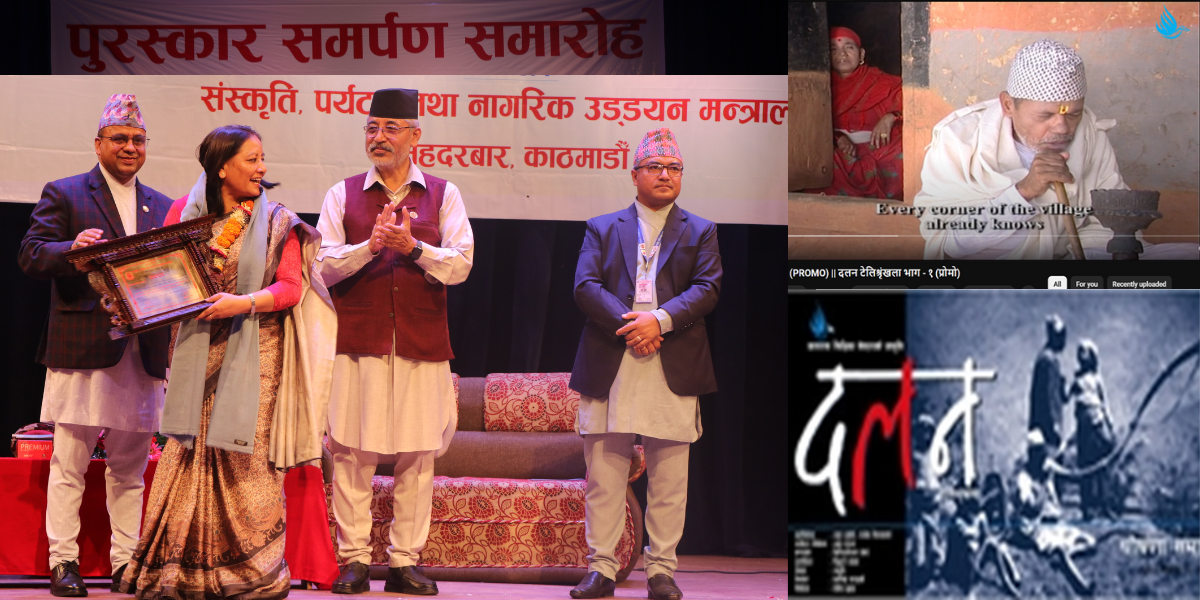
Kathmandu – Dalan, the powerful Nepali television series produced by Jagaran Media Center (JMC), has been awarded the Bhagat Sarvajit National Human Dignity Award 2081, presented by the Ministry of Culture, Tourism, and Civil Aviation of Nepal.
In a special ceremony held at the National Dance Hall in Kathmandu, Minister Badri Prasad Pandey presented the prestigious award to Kamala Bishwakarma, Chairperson of Jagaran Media Center. The ministry recognized Dalan for its bold and realistic portrayal of caste-based discrimination and untouchability, which are deeply entrenched in Nepali society.
According to the ministry, Dalan has significantly contributed to raising awareness about social injustices through its impactful narrative. Chairperson Kamala Bishwakarma, while accepting the award, remarked:
“Receiving this honor after more than a decade of producing Dalan gives us renewed energy and encouragement. This award not only recognizes Jagaran Media Center but also the contributions of the writers, directors, actors, cinematographers, editors, and the entire production team. We thank everyone involved.”
Originally aired in 2009, Dalan remains one of the most influential television series in Nepal’s media history. It highlights the historical and ongoing oppression faced by the Dalit community, particularly from so-called “upper-caste landlords,” and has inspired critical dialogue around caste-based discrimination.
Beyond its artistic and cultural significance, Dalan has become a symbol of advocacy and social change. Over the years, Jagaran Media Center has continued to combat caste-based injustice through media, operating Radio Jagaran in Butwal, promoting inclusive journalism, and engaging in rights-based campaigns across the country.
Dalan is a widely acclaimed teleserial produced by Jagaran Media Center (JMC), depicting the hardships, oppression, and struggles of the Dalit community in Nepal. Directed by Nabin Subba, the 52-episode series aired on Nepal Television every Saturday at 8:30 PM in 2009.
Despite being completed more than a decade ago, Dalan remains one of Nepal’s most impactful and socially significant television productions. Its realistic portrayal of caste-based oppression resonated with audiences across the country, from the hills where the story is set to the Terai and the Kathmandu Valley.
The series centers around systemic caste discrimination, particularly against Dalits, and the violence, exclusion, and marginalization they endure. The powerful storyline and relevance of the series sparked the formation of more than 500 “Dalan Viewers’ Clubs” in Nepal and abroad—including in India, Malaysia, the UAE, the US, and the UK. These clubs played a vital role in advancing JMC’s mission of justice and equality.
Due to its deep social impact, Dalan received awards from Nepal Television and the One World Media (UK). While the series is set in the past, it continues to reflect the current realities of caste-based discrimination, particularly in rural Nepal. Its strength lies in its authentic storytelling, which gave voice to the marginalized and challenged the status quo.
The teleserial featured renowned Nepali actors such as Anup Baral, Diya Maskey, Puran Singh Baraily, and Anju Niraula. It was produced by Puran Singh Baraily and filmed primarily in rural areas of the Baglung district, providing a natural and immersive backdrop rather than relying on studio sets.
Post-production was completed at AVES Studio in Anamnagar, Kathmandu, with editors Shiva Puri, Kiran Giri, Rakshya Singh Rana, and Arun Sharma. Their outstanding work earned Dalan the Best Editing Award, further cementing its legacy.
Written by Ahuti and directed by Nabin Subba, Dalan serves as a powerful lens into the social realities of Dalits in Nepal. From a subaltern perspective, the series delves into the political consciousness, social struggles, and ideological awakening of Nepal’s marginalized communities. It not only entertained but also empowered, making it a landmark in Nepali media’s role in social transformation.